
Currently Empty: $0.00

Why Cybersecurity Audits Are Becoming Essential for Modern Law Firms
By Ashish Kolte, Marketing Manager at DataIntelo
Law firms rely on digital systems to manage confidential client information, contracts, financial records, evidence, case strategies, and privileged communications. Email, cloud storage, electronic filing, video meetings, document-management platforms, billing systems, and e-discovery tools have improved efficiency—but they have also created additional security risks.
A cybersecurity audit helps a firm examine how information is protected, identify weaknesses, and prioritize improvements. It does not guarantee that a cyberattack will never occur. Instead, it provides a structured way to evaluate the firm’s technology, policies, employees, and vendors.
For lawyers, cybersecurity is not only a technology concern. It may also involve professional duties relating to competence, confidentiality, supervision, and communication with clients.
Why cybersecurity matters to law firms
Law firms may hold information that is valuable to criminals, competitors, or other unauthorized parties. Depending on the firm’s practice areas, its systems may contain:
- Personally identifying information
- Financial and banking information
- Medical records
- Business contracts and trade secrets
- Litigation strategies and settlement positions
- Intellectual property
- Confidential client communications
- Credentials used to access court, government, or third-party systems
A security incident can therefore create more than a technical problem. It may interrupt legal services, expose confidential information, damage client relationships, and create legal, contractual, regulatory, or professional-responsibility concerns.
The American Bar Association’s cybersecurity guidance identifies several professional-responsibility rules and formal opinions relevant to protecting client information. These include competence, confidentiality, supervision, and obligations following an electronic data breach. The specific requirements for a lawyer depend on the applicable jurisdiction and circumstances.
What is a cybersecurity audit?
A cybersecurity audit is a structured review of an organization’s security controls, policies, systems, and procedures. For a law firm, the review should consider both technology and legal-workflow risks.
A useful audit may examine:
- Who can access client and firm information
- Whether access is limited according to job responsibilities
- How passwords and multifactor authentication are managed
- Whether former employees and inactive accounts have been removed
- Whether software and operating systems are updated
- How confidential data is stored, transferred, and deleted
- Whether cloud providers and vendors have been evaluated
- How backups are created and tested
- Whether devices are protected against malware
- How employees are trained to recognize phishing and other threats
- Whether the firm has an incident-response plan
- Whether security policies are documented and reviewed
The audit should produce more than a list of technical weaknesses. It should identify the firm’s most important risks, recommend corrective actions, assign responsibility, and establish a method for tracking progress.
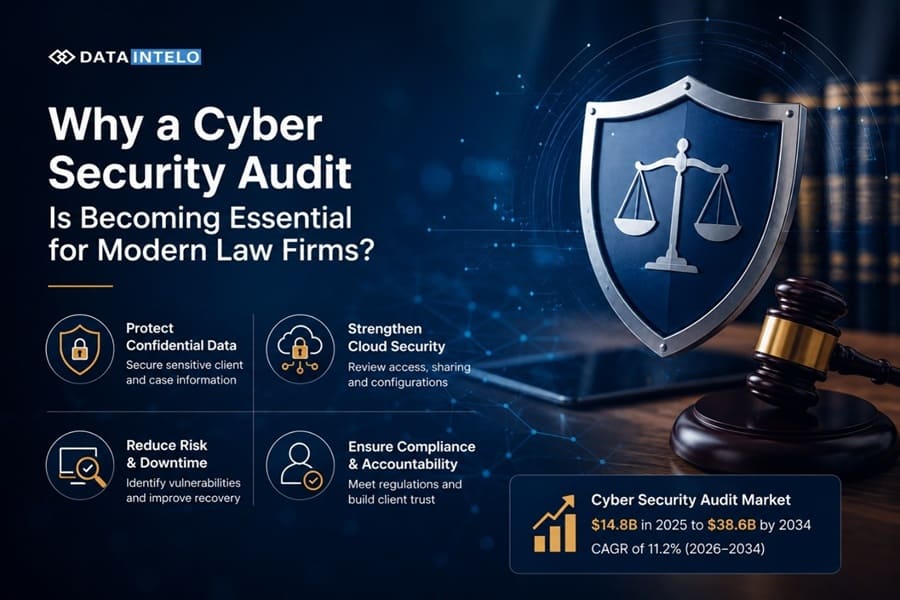
The growing interest in cybersecurity audits is also reflected in the broader security-services market. According to a DataIntelo report on the global cyber security audit market , the market is projected to expand from an estimated $14.8 billion in 2025 to $38.6 billion by 2034. These figures are market-research estimates, not evidence that every law firm must conduct an audit. For individual firms, the more important question is whether their security review is appropriate to the sensitivity of client information, the technology they use, and the risks they face.
1. Access controls should match job responsibilities
One of the first audit questions should be whether employees have more access than they need.
A receptionist may not need access to litigation files, while a billing employee may not need access to every client’s medical records. Excessive permissions can increase the impact of a compromised account or an accidental disclosure.
A law firm should consider:
- Using individual user accounts instead of shared credentials
- Applying role-based access permissions
- Requiring multifactor authentication where available
- Reviewing administrator accounts
- Removing access promptly when employees leave
- Limiting access to sensitive folders and applications
- Reviewing permissions when an employee changes roles
The firm should document access reviews and retain evidence of corrective action. The appropriate review frequency will depend on the firm’s size, systems, staffing changes, and risk profile.
2. Cloud systems and vendors require careful review
Cloud services can improve collaboration and remote access, but moving information to the cloud does not eliminate the firm’s responsibility to evaluate security.
The ABA explains that lawyers must make reasonable efforts to protect information relating to a client’s representation and should consider the risks associated with technology used in legal practice. Formal Opinion 477R discusses securing electronic communications, while Formal Opinion 498 addresses issues connected with virtual practice.
A cloud-services review should ask:
- What information does each service store?
- Which employees and vendors can access it?
- Is multifactor authentication enabled?
- How does the provider handle encryption and account recovery?
- How long is information retained?
- What happens when an account is closed?
- What contractual protections apply?
- How can the firm retrieve its information if the provider becomes unavailable?
- What is the provider’s process for reporting a security incident?
The firm should also evaluate managed-service providers, document-management companies, e-discovery providers, payroll services, and other vendors that may access confidential information.
A vendor should not be considered secure merely because its marketing materials use terms such as “enterprise-grade” or “bank-level security.” The firm should review the provider’s actual controls, contractual commitments, incident-notification procedures, and responsibilities.
3. Backups must be available and usable
Backups can help a firm recover from ransomware, hardware failure, accidental deletion, and other events that make files inaccessible.
A firm should determine:
- Which systems and files are backed up
- How frequently backups occur
- Whether backups are protected from unauthorized alteration
- Whether some backups are separated from the primary environment
- Who can access or delete backups
- How long backups are retained
- How restoration would occur after an incident
- Whether restoration has been tested
A backup that has never been restored may not provide the protection the firm expects. Testing should confirm that important files can be recovered and that the firm understands how long recovery may take.
The Federal Trade Commission’s cybersecurity guidance for small businesses provides practical information on protecting systems, securing networks, and preparing for incidents. It can serve as a useful starting point for smaller firms, although it should not be treated as a substitute for a firm-specific assessment.
4. Employee training is a core security control
Technology alone cannot prevent every security incident. Employees may encounter phishing emails, fraudulent payment requests, malicious attachments, fake login pages, or social-engineering attempts.
Training should address:
- How to identify suspicious messages
- How to verify unusual payment or wire-transfer requests
- Why passwords should not be reused
- How to use multifactor authentication
- How to report suspected incidents
- What information may be entered into online tools
- How to handle confidential documents
- Why personal devices and removable drives may create risks
Training should be connected to the firm’s actual workflows. For example, employees who regularly receive settlement instructions or transfer requests should understand how to verify changes in payment details through a trusted communication channel.
The ABA has emphasized that cybersecurity programs should include training and ongoing security awareness, including for lawyers, staff, and other users of firm technology.
5. Artificial intelligence creates additional review questions
Many law firms are evaluating or using artificial-intelligence tools for research, drafting, summarization, transcription, document review, and administrative work.
Before employees use an AI service with client-related information, the firm should establish rules addressing:
- Which tools are approved
- What information may be entered
- Whether confidential or privileged information is prohibited
- How vendor data is stored and retained
- Whether submitted information may be used to improve the service
- Who is responsible for reviewing AI-generated work
- How legal authorities and factual statements will be verified
- Whether the tool connects to other firm systems
- How access is removed when an employee leaves
AI-generated content should not be treated as accurate merely because it appears polished. Lawyers remain responsible for professional judgment, confidentiality, accuracy, and appropriate review.
The firm should also maintain an inventory of approved AI tools and identify who is responsible for reviewing their terms, security settings, and permitted uses. The review schedule should reflect the firm’s technology environment and risk level rather than an arbitrary requirement that every firm conduct the same number of reviews each year.
6. Smaller firms can begin with practical priorities
A smaller firm may not have a dedicated information-security department. That does not mean it must address every issue at once.
A practical starting point may include:
- Create an inventory of devices, applications, cloud services, and sensitive information.
- Enable multifactor authentication on email, cloud storage, remote access, and administrative accounts.
- Remove inactive accounts and review administrator permissions.
- Establish a process for applying security updates.
- Confirm that backups exist and test the restoration process.
- Provide employees with phishing and incident-reporting training.
- Document how the firm will respond to a suspected breach.
- Review the security practices of important technology vendors.
- Establish rules for using AI tools with client information.
- Schedule periodic reviews and track unresolved issues.
These are risk-management priorities, not universal legal requirements. The appropriate controls will vary according to the firm’s practice areas, size, technology environment, insurance requirements, contractual obligations, and applicable law.
The NIST Cybersecurity Framework 2.0 offers a flexible structure organized around Govern, Identify, Protect, Detect, Respond, and Recover. NIST also provides a Small Business Cybersecurity Corner for organizations that need a more accessible starting point.
7. A cybersecurity audit should produce measurable results
A firm can use a simple tracking document to monitor its progress.
| Audit area | Questions to evaluate | Possible evidence |
| Access control | Are permissions limited and reviewed? | Access lists and review records |
| Authentication | Is multifactor authentication enabled? | System settings and security reports |
| Software updates | Are critical updates applied? | Patch and maintenance records |
| Backup recovery | Can important files be restored? | Restoration test results |
| Cloud security | Have providers and settings been reviewed? | Vendor records and configuration reports |
| Endpoint protection | Are laptops and workstations protected? | Security software reports |
| Staff training | Do employees know how to report threats? | Training records and exercises |
| Incident response | Does the firm know what to do after an incident? | Written response plan and contact list |
The goal is not to achieve a perfect score. It is to identify meaningful risks, address them in a reasonable order, and retain evidence that the firm is actively managing cybersecurity.
8. Cybersecurity should be reviewed regularly
A cybersecurity audit is not a one-time solution. A firm’s risks can change when it:
- Opens a new office
- Adds remote employees
- Adopts a new cloud platform
- Changes its document-management system
- Begins using AI tools
- Adds a new practice area
- Changes technology vendors
- Experiences staff turnover
- Handles more sensitive information
- Responds to a security incident
A firm may conduct a broader annual review and perform smaller checks throughout the year. The schedule should reflect the firm’s risk profile and available resources.
The ABA’s guidance emphasizes that reasonable safeguards depend on factors such as the sensitivity of the information, the likelihood of disclosure, the cost and difficulty of implementing safeguards, and the effect on the lawyer’s ability to represent clients.
Frequently asked questions
Is a cybersecurity audit required for every law firm?
Not necessarily. Whether an audit is required or advisable depends on applicable professional rules, contractual obligations, insurance requirements, regulatory duties, and the firm’s circumstances. Even when no specific audit is mandated, a review can help the firm identify and manage risks.
How often should a law firm conduct a cybersecurity audit?
There is no single schedule that fits every firm. A firm should consider its size, technology, practice areas, vendor relationships, and changes in risk. A broad annual review, supplemented by periodic checks, may be a practical approach for many organizations.
Can a cybersecurity audit prevent a data breach?
No audit can guarantee that a breach will not occur. An audit can identify weaknesses and help the firm improve its ability to prevent, detect, respond to, and recover from incidents.
Should a law firm include its vendors in the audit?
Yes. Vendors may store, process, or access confidential information. Reviewing their security practices, contracts, access rights, and incident-notification procedures can help the firm understand third-party risks.
What should a firm do after discovering a possible breach?
The firm should follow its incident-response plan, preserve relevant evidence, involve appropriate technology and legal professionals, and evaluate whether notification or other obligations apply. The response will depend on the nature of the incident, the information involved, and the jurisdictions concerned.
ABA Formal Opinion 483 discusses lawyers’ obligations after an electronic data breach or cyberattack, including investigating what happened, restoring systems, and communicating with affected clients when required. It also recognizes that other privacy and breach-notification laws may apply.
Conclusion
Cybersecurity audits are an important part of responsible law-firm management. They help firms move beyond general security promises and examine whether their actual systems, policies, employees, and vendors are protecting confidential information.
A well-designed audit should be practical, documented, and proportionate to the firm’s risks. By reviewing access controls, cloud services, backups, employee training, AI use, vendor relationships, and incident-response procedures, law firms can improve their security posture while maintaining the trust that is essential to the attorney-client relationship.
Authorities and sources
- American Bar Association – Cybersecurity Resources
- ABA Formal Opinion 477R – Securing Communication of Protected Client Information
- ABA Formal Opinion 483 – Lawyers’ Obligations After an Electronic Data Breach or Cyberattack
- ABA Formal Opinion 498 – Virtual Practice
- NIST Cybersecurity Framework 2.0
- NIST Small Business Cybersecurity Corner
- Federal Trade Commission – Cybersecurity for Small Business
