
Currently Empty: $0.00

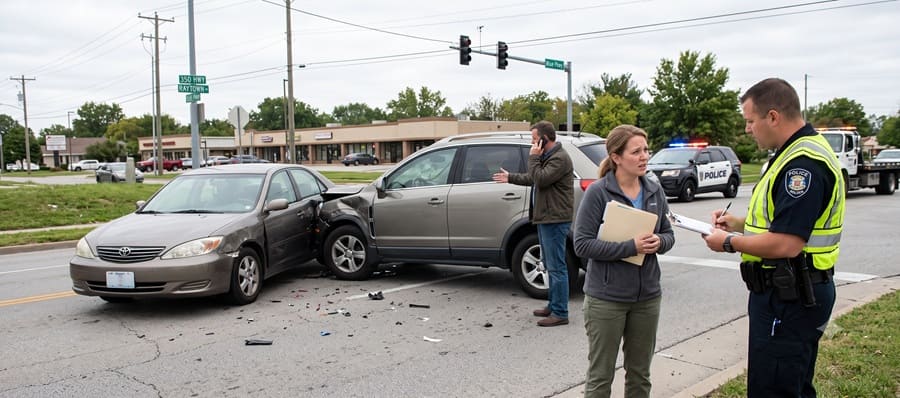
After a Car Accident in Raytown, Missouri: Your Options, Deadlines, and How Fault Is Decided
By Mike Mohlman, Trial Attorney, Mohlman Injury Law (Kansas City, Missouri) | Last reviewed: October 2026
Raytown sits at a busy crossroads of eastern Jackson County, with Highway 350, Blue Ridge Boulevard, and quick access to I-435 and I-470 carrying commuters in and out of Kansas City every day. A crash on any of them can take seconds, while the medical bills, missed work, and insurance calls that follow can stretch on for months.
Missouri Car Accident Law in One Minute
Missouri is an at-fault state, so the driver who caused the crash, through their liability insurer, pays for the other side’s losses. Missouri uses pure comparative fault: you can recover even if you were partly to blame, minus your share. You generally have five years to file an injury lawsuit, and every Missouri auto policy must include uninsured motorist coverage.
The First Hour: At the Scene
- Move to safety if you can, without leaving the scene, and call 911. A police report is the starting point for nearly every claim.
- Check on others and get medical help for anyone who needs it.
- Exchange names, phone numbers, driver’s license details, insurance information, and vehicle plates.
- Photograph the vehicles, the road, traffic signals, skid marks, and any injuries; note nearby businesses that may have cameras.
- Get witness names and phone numbers before they leave.
Stick to facts when talking with the other driver and the police. Apologizing or guessing about speed can later be quoted out of context. Police reports carry significant weight but aren’t the final word on fault, as this look at how a police report can help a car accident claim explains.
The First Week: Medical Care and Reporting
See a doctor promptly, even if you feel fine. Whiplash, concussions, and soft-tissue injuries often show up hours or days later, and a gap between the crash and the first visit is one of the first things insurers point to when disputing an injury.
Report the crash to your own insurer. If the crash caused injury, death, or more than $500 in property damage and any driver was uninsured, Missouri also requires a report to the Department of Revenue within 30 days (RSMo 303.040); the Department of Revenue explains the process.
How Fault Is Decided in Missouri
Missouri courts apply pure comparative fault. Each party is assigned a percentage of responsibility, and an injured person’s recovery is reduced by their own share. A driver found 20% at fault for a $50,000 loss would recover $40,000. Unlike in many states, including neighboring Kansas, there is no cutoff: even a driver found mostly at fault can recover a reduced amount from the other party.
Evidence decides those percentages: the police report, photos, witness accounts, vehicle damage patterns, traffic camera footage, and phone records. Missouri’s hands-free law, effective August 28, 2023 (RSMo 304.822), bars drivers from holding or using a phone while driving, which can make a distracted driver’s phone use important evidence.
Where the Money Comes From
| Source | What it covers |
| At-fault driver’s liability insurance | Your losses, up to the policy limits; Missouri minimums are $25,000 per person and $50,000 per accident for injuries |
| Your uninsured motorist (UM) coverage | Required on every Missouri policy; applies when the at-fault driver has no insurance or flees |
| Your underinsured motorist (UIM) coverage | Optional; helps when the at-fault driver’s limits are too low for your losses |
| Medical payments coverage | Optional; pays medical bills regardless of fault |
| Health insurance | Treatment costs, usually with a right to be repaid from any settlement |
Missouri’s minimum liability limits (RSMo 303.190) are low compared with the cost of a serious injury, so checking your own UM and UIM coverage is often one of the most important early steps. Uninsured motorist coverage is required and cannot be waived (RSMo 379.203).
If a city, county, or state vehicle was involved, Missouri waives sovereign immunity for injuries caused by a public employee’s negligent operation of a motor vehicle, subject to limits on recovery (RSMo 537.600). Those claims have their own rules and should be reviewed early.
What Compensation Can Include
- Medical expenses, past and future, including emergency care, therapy, and medication. Missouri juries may consider the amounts actually paid to providers, not only the amounts billed (RSMo 490.715).
- Lost income and, for lasting injuries, reduced earning capacity.
- Pain, suffering, and emotional distress.
- Vehicle repair or replacement and other property damage.
A Rear-End Crash Where the Driver’s Conviction Mattered
One of the cases on Mohlman Injury Law’s case results page involved a high school student riding on a band bus when a truck crashed into the rear of the bus. She suffered multiple fractures and internal injuries. The truck driver was convicted of driving too fast for conditions, and her family settled the case for more than $630,000.
Rear-end collisions are among the most common crashes on busy corridors like Highway 350. A traffic conviction arising from the crash can be powerful evidence of fault in the civil claim, though the injury case still requires proof of what the injuries are and what they will cost.
Past results do not guarantee similar outcomes. Every case depends on its own facts.
The Months After: Insurers, Settlements, and Deadlines
Talking with insurers
The other driver’s insurer may ask for a recorded statement or broad medical authorizations. You aren’t required to give a recorded statement to the other driver’s insurer, and statements made before you know the full extent of your injuries can be used later to minimize the claim.
Settlements are final
A settlement usually requires signing a release that ends the claim for good. Settling before treatment is finished risks leaving future care uncompensated. Missouri also regulates time-limited settlement demands sent to insurers before a lawsuit (RSMo 537.058), setting requirements for what the demand must include and how long the insurer has to respond. For a sense of how long the process usually takes, see how long a personal injury claim takes.
Filing deadlines
- Personal injury and property damage: generally five years from the crash (RSMo 516.120).
- Wrongful death: generally three years (RSMo 537.100).
Those deadlines are longer than in many states, but evidence such as camera footage and witness memories fades within weeks.
When Legal Help Makes Sense
A fender bender with no injuries can often be resolved directly with the insurers. Cases involving significant injuries, disputed fault, an uninsured driver, a commercial vehicle, or multiple parties are different. People in those situations often consult a trusted car accident lawyer in Raytown, MO or elsewhere in the Kansas City area before giving statements or signing a release. Most personal injury lawyers work on contingency, so the consultation and fee arrangement should be explained in writing.
Frequently Asked Questions
How long do I have to file a car accident claim in Missouri?
Generally five years for personal injury and property damage, and three years for wrongful death.
Can I recover if I was partly at fault for a car accident in Missouri?
Yes. Missouri uses pure comparative fault, so your recovery is reduced by your percentage of fault but not barred.
What if the driver who hit me in Raytown had no insurance?
You can claim against your own uninsured motorist coverage, which every Missouri auto policy must include.
Do I have to give the other driver’s insurer a recorded statement?
No. You should report the crash to your own insurer, but you aren’t required to give a recorded statement to the other driver’s company.
Disclaimer
This article provides general information about Missouri car accident law and is not legal advice. Reading it does not create an attorney-client relationship. Every case depends on its facts, and laws change. For advice about your situation, consult a licensed Missouri attorney.
