
Currently Empty: $0.00

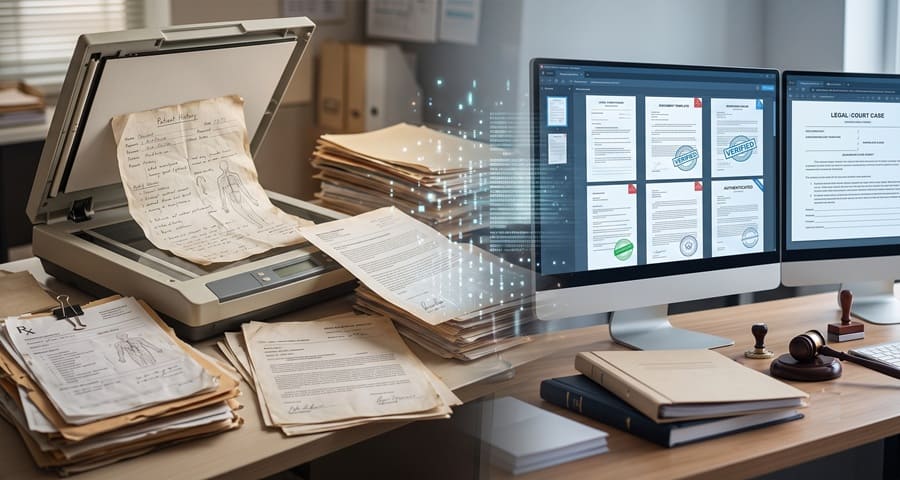
From Scanned Medical Records to Verifiable Legal Documents
By Stacy Lebbon, Esq., Manager, AI and Managed Review, Complete Legal | Last reviewed: October 2026
Picture a personal injury file that arrives as a folder of scanned hospital records, handwritten physician notes, and CMS-1500 billing forms. An AI-assisted draft quickly turns it into a tidy treatment history and a medical-expense total. It reads well. But one charge is missing a zero, and a sentence about symptoms says the opposite of what the physician wrote.
That example, which this article follows throughout, shows why source verification has to start long before anyone polishes the prose. Three different qualities are at stake. A document is readable when it makes sense. It is accurate when its statements faithfully reflect the evidence. It is verifiable when a reviewer can find that evidence and check what the document says about it. Getting from scanned pages to defensible work product means protecting those connections through character recognition, data extraction, AI summarization, and professional review.
Quick Summary
- Most consequential errors in AI-assisted record summaries start upstream, when scanned text is misread, and are then repeated fluently by the model.
- Final review should compare the finished document against the original page images, not against the OCR text, which would only confirm the same mistake.
- Summaries should keep facts, qualified medical opinions, and the drafter’s inferences separate.
- Every material assertion should carry a pinpoint source reference, and the attorney remains responsible for what is filed or sent.
OCR Determines What the Next System Can Read
An image-only PDF contains pictures of words with no embedded text layer. A text-only large language model (LLM) pipeline cannot extract text that is not there. Multimodal models can interpret page images directly, but optical character recognition (OCR) remains useful for long, mixed case files, particularly when software needs reusable text, searchable pages, or structured fields. Born-digital PDFs with reliable text generally do not need OCR, so processing should handle mixed files page by page.
Several tools are commonly used. Google Cloud Vision recognizes printed and handwritten text and returns layout and coordinates. Google Document AI is a separate platform for OCR, form parsing, and structured extraction. Azure AI Document Intelligence recognizes print and handwriting, and Amazon Textract extracts forms and tables. Vision-language tools such as olmOCR produce Markdown while handling reading order and tables. These descriptions are of capabilities, not equivalent accuracy.
Before uploading patient records to any service, review its contract terms, retention settings, access controls, and permitted data uses. Personal injury firms are often not HIPAA covered entities themselves, but they still owe clients a duty to protect confidential information, and some engagements do bring HIPAA obligations; HHS’s guidance on cloud computing explains when a business associate agreement is required.
Preserve characters and their relationships
On a CMS-1500 claim form, dates, procedure codes, diagnosis pointers, and charges sit in neighboring boxes, and item 24F holds each service line’s charge. The form’s red ink is designed for scanners that drop out the grid lines, but a law firm’s photocopied scan often keeps them. Intersecting borders, stamps, and faint digits all complicate recognition. Extraction has to preserve both the characters and their association with the correct row and field. A perfectly transcribed amount assigned to the wrong treatment line is still wrong.
Read accuracy figures in context
OCR accuracy is often reported as character error rate (CER): the number of character substitutions, deletions, and insertions needed to match a checked reference transcription, divided by its length. Lower is better. Word error rate, field-extraction precision, and layout scores measure different things. A low average CER can still hide one consequential error in a charge or a diagnosis.
Published benchmarks rarely involve medical forms. In an ACL 2024 paper, Carlson, Bryan, and Dell report a Google Cloud Vision CER of 0.5% on an English historical-newspaper text-line benchmark, but 69.5% on historical vertical Japanese tables, and they note that layout errors affect whole-page results. A 2025 study by Miller and Banerjee found strong but uneven performance from vision-language OCR on early-twentieth-century scans. Neither establishes performance on billing forms or physicians’ handwriting, and vendor or blog comparisons that do not state their metric or method should not be read as validated accuracy figures.
Handwriting deserves particular caution. Modern OCR can sometimes read handwriting that is difficult even for a person, but handwritten notes remain less reliable than clean print. Statements drawn from them belong at the top of the final review list.
Why a Fluent Summary Can Repeat an OCR Mistake
Back to the example file. A box border hides a zero in a CMS-1500 charge field, and OCR reads $1,250 as $125. The LLM, working only from extracted text, faithfully carries $125 into a billing table and the narrative. The finished document now understates that line by $1,125, and nothing about the number looks wrong.
The model may never have seen the page image. A plausible charge does not announce that it was misread. Comparing the final document with the original image catches the missing zero; comparing it only with the OCR text confirms the error a second time.
The same file contains a handwritten note reading “no radicular pain.” If recognition drops the word “no,” the text supports a coherent but clinically false summary that the patient reported radicular pain. Short qualifiers, abbreviations, and ambiguous strokes deserve attention even when the surrounding transcription looks excellent.
Accurate OCR does not eliminate model error. An LLM can still omit an encounter, attribute one provider’s statement to another, double-count a bill, miscalculate a total, or infer something the records never say. Automated checks can flag inconsistent totals, duplicate charges, and odd dates, but a total that reconciles can still contain a wrong line item. Verification has to test what the final document asserts against what the source actually supports.
Keep Recorded Facts Separate From Medical Causation
Suppose the claimant has an MRI after the collision. The report notes degenerative findings, and a later physician note says the collision “may have aggravated” a pre-existing condition. There are now three distinct things: the imaging findings, the physician’s qualified opinion, and the drafter’s explanation of why they matter.
A good summary keeps those boundaries. The MRI date shows when imaging happened, not when a condition began. Rewriting “may have aggravated” as “the collision caused” overstates the medical opinion, and a patient’s report that symptoms started after the crash should remain identified as patient history rather than becoming a physician’s conclusion. AI can gather the relevant statements and surface tensions between them, but the attorney and appropriate medical professionals have to decide what conclusions the records support, and uncertainty should stay visible until the evidence resolves it.
The Legal Standards Behind Verifiable Work Product
Verifiability is not only good practice; it maps onto how records are used and challenged in litigation.
- Under Federal Rule of Evidence 901, the proponent must show an item is what it claims to be. Clear provenance for each page makes that easier.
- Rule 1003 generally allows a duplicate in place of an original unless there is a genuine question about authenticity or unfairness. A legible scan helps; an altered or incomplete one invites challenge.
- Business records. Medical and billing records are commonly offered under the business-records exception in Rule 803(6), often with a custodian’s certification under Rule 902(11). Summaries and chronologies are work product built on those records, not substitutes for them.
- Professional responsibility. ABA Formal Opinion 512 (July 2024) says lawyers using generative AI must understand its limits, independently verify its output to an appropriate degree, protect client confidentiality, and supervise both staff and vendors. Courts have sanctioned lawyers for filing AI-generated content they did not check.
Rules specifically addressing machine-generated evidence are still developing. A proposed Federal Rule of Evidence 707 was published for comment in 2025, but as of August 2026, the Advisory Committee had paused the proposal to gather more input, so existing rules continue to govern.
Make the Finished Document Easy to Trace
Traceability depends on information architecture. Keep the original files, create searchable working copies, assign stable document labels, and preserve page references through merging and exhibit assembly. The OCR layer makes scans searchable, but the page image is what settles a disputed word or number.
Give each material assertion a useful source location: exhibit identifier, page number, and, where needed, service date or form field. In the example file, “Exhibit A-3, page 2, item 24F, service dated April 8” takes a reviewer straight to the charge. A provider name alone does not. Keep that reference with the billing-spreadsheet row so a corrected amount flows through the narrative and totals. Test bookmarks and links in the exported PDF, since navigation in an editable draft does not always survive conversion.
The same principle applies when record review is handed to an outside team. Whether the work is done in-house or through medical record review services, the deliverable should let the attorney move from any chronology entry or billing line back to the exact page that supports it, with missing documentation and conflicting entries flagged rather than smoothed over. Find an Attorney’s overview of how technology is changing the way attorneys build cases covers related tools.
A Single, Risk-Prioritized Final Check
One practical design is to process, extract, and draft first, then conduct one deliberate comparison of the assembled document against the original page images before attorney approval and release. Automated flags can accumulate during processing without a full manual review of every intermediate file. Priorities for that review:
| Check first | Why |
| Dollar amounts, decimals, and totals | Single-digit OCR errors change damages figures |
| Dates and patient or provider identities | Misattribution undermines the chronology |
| CPT and ICD codes from poor scans or boxed forms | Grid lines and stamps interfere with recognition |
| Handwritten diagnoses, qualifiers, and medications | Dropped words like “no” reverse meaning |
| Causation statements | Qualified opinions must stay qualified and attributed |
In the example file, this pass restores the zero, the missing negative, and the physician’s qualification, and the corrections then carry through every dependent table and paragraph. One consolidated review is a reasonable allocation of effort, not a rule that satisfies every professional obligation. Illegible pages, missing records, or new contradictions may require clearer copies, provider clarification, or further investigation. Clients can help from the start by keeping their own records organized; this guide to documenting injuries after an accident explains what to keep.
The Standard to Aim For
The useful test for an AI-assisted legal document is whether a reviewer can move from a material assertion to its evidence and understand the inference being drawn. Preserve the original images, favor accurate transcription, keep uncertainty visible, and make the final check against the source rather than the intermediate text. That gives the person who signs the document a real basis for taking responsibility for it.
Disclaimer
This article provides general information about document processing and verification practices in legal work. It is not legal advice, and it does not endorse any particular software product. Evidence rules, ethics guidance, and privacy obligations vary by jurisdiction and engagement, and attorneys remain responsible for reviewing and verifying all work product before it is filed or sent.
