
Currently Empty: $0.00

Can Florida Police Unlock Your Phone in a Sex Crime Investigation?
By Chavelys Y. Alers, Founding Attorney, Alers Law Firm, Orlando, Florida · Member of The Florida Bar since 2013 | Updated November 2026
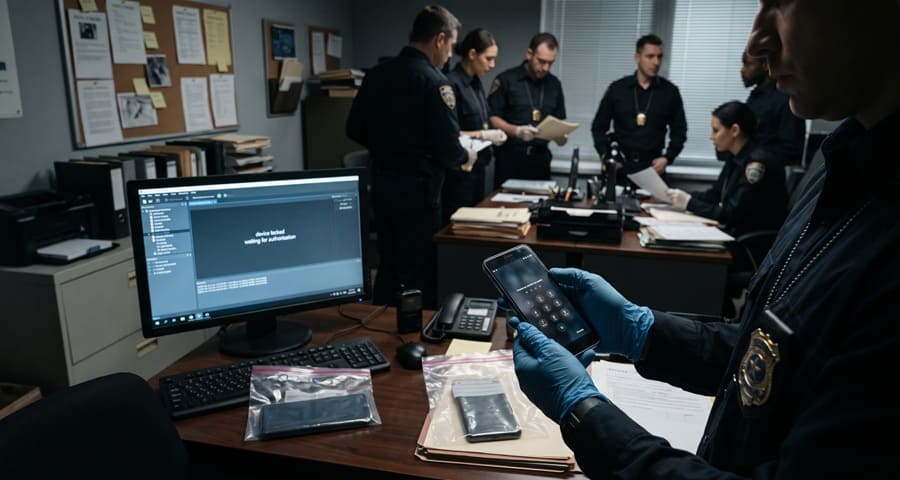
In a sex crime investigation, a phone often matters more than any witness. Messages, photos, location history and app data can be used to build a case, and police know it. People under investigation are often surprised by how quickly an officer asks them to hand over the device and unlock it.
Police can take a phone in many situations. Searching it is a different matter. Whether they can make you unlock it is a question Florida courts still haven’t fully answered. What you say and do in the first few minutes after police ask for your phone can shape the case that follows.
The Short Answer
- Police generally need a warrant to search the contents of a phone, even after an arrest (Riley v. California, 2014).
- Officers can sometimes seize a phone without a warrant and hold it while they apply for one.
- If you give your passcode or agree to a search, you may waive protections you would otherwise have.
- Florida appeals courts disagree about whether a court can order you to reveal a passcode, and the Florida Supreme Court has not settled the question.
- Deleting data after you know you are under investigation can lead to a separate felony charge.
Why Investigators Want Your Phone
Sex crime cases often turn on communications and timing. Investigators commonly look for:
- texts, direct messages and app chats with the accuser or an undercover officer
- location data and timestamps that place someone at a specific place
- photos and videos, including file data that shows when and where they were created
- social media activity and dating-app profiles
- cloud backups and deleted files that forensic tools may recover
- contacts that point to possible witnesses
In online sting cases, such as charges for traveling to meet a minor or soliciting a minor, the chat history on the phone is often the core of the State’s case. Our earlier article on how social media can affect a criminal case covers how posts and messages get used as evidence.
Seizing a Phone Is Not the Same as Searching It
The common belief that police need a warrant to take a phone, is only partly true. The Fourth Amendment and Article I, Section 12 of the Florida Constitution treat seizing a device and searching its contents as separate steps.
Officers may take a phone without a warrant in some situations, for example during an arrest or when they reasonably believe evidence on it could be destroyed before they can get a warrant. That lets them hold the device. It does not let them scroll through it.
To look at what is on the phone, police generally need a search warrant backed by probable cause. In Riley v. California, the U.S. Supreme Court held that officers may not search a phone’s digital contents just because they arrested the person carrying it. The Court has also required a warrant for historical cell-site location records in Carpenter v. United States (2018), and the Florida Supreme Court required one for real-time cell-site tracking in Tracey v. State (2014).
A warrant is not unlimited, either. It should describe what officers may search for. A search that goes far beyond those limits, or a warrant based on a weak or stale affidavit, can be challenged with a motion to suppress.
Why Giving Your Passcode Can Hurt You
When an officer asks for your passcode or asks you to unlock the phone with your face or fingerprint, it may sound routine. It isn’t. If you agree, the search can be treated as consensual, and the State may argue no warrant was needed. Consent can be limited or withdrawn, but in practice, once a phone is open, officers can download a great deal very quickly.
The safer response is to stay calm, say that you do not consent to any search, and say that you want to speak with a lawyer. Do not physically resist if officers take the phone. Any dispute about the seizure gets handled in court, not on the street.
Saying no should not be used against you at trial. In McRoberts v. State, 333 So. 3d 240 (Fla. 4th DCA 2022), a defendant charged with traveling to meet a minor first refused to give officers his passcode. The State told the jury about the refusal. The Fourth District reversed the conviction, holding that it is improper for the State to use a defendant’s invocation of his rights as evidence against him.
Can a Florida Court Order You to Reveal Your Passcode?
This is where Florida law is unsettled. The Fifth Amendment protects people from being forced to give testimony against themselves. Courts have split on whether reciting a passcode counts as testimony.
- State v. Stahl, 206 So. 3d 124 (Fla. 2d DCA 2016): The Second District held that a suspect in a video voyeurism case could be compelled to provide his passcode, reasoning that the State already knew the phone was his and that the passcode existed.
- A.Q.L. v. State, 257 So. 3d 1058 (Fla. 4th DCA 2018): The Fourth District disagreed, holding that forcing a minor to reveal his passcode was testimonial and that the State had not shown it already knew, with reasonable particularity, what was on the phone.
- Garcia v. State (Fla. 5th DCA 2020): The Fifth District held that compelled disclosure of a passcode is testimonial and protected, and certified the conflict with Stahl to the Florida Supreme Court.
The Florida Supreme Court took up Garcia but, in State v. Garcia (2022), decided it on a procedural ground without answering the Fifth Amendment question. As a result, trial courts can reach different answers depending on where a case is filed, and the issue remains open statewide.
Biometric unlocking adds another layer. Some courts outside Florida have treated a forced fingerprint or face scan as non-testimonial, like giving a fingerprint at booking. Others have reached the opposite result. Florida appellate courts have said less about biometrics than about passcodes, so this area remains uncertain.
Police Don’t Always Need Your Phone
Even without a passcode, investigators can often get much of the same information elsewhere:
- cloud accounts, through a warrant or legal process served on the provider
- messages from the other person’s phone, if that person shares them
- synced data on tablets, laptops or shared accounts
- direct messages, through legal process served on the social media company
- metadata and subscriber information
- carrier records, including call logs and some location data
That is one reason a locked phone does not mean an investigation stops. It also means a defense lawyer will often look closely at how each piece of digital evidence was obtained, since each source has its own legal requirements.
Don’t Delete Anything
If you think you are under investigation and police have not taken your phone, do not delete messages, wipe the device or close accounts. Under section 918.13 of the Florida Statutes, destroying or concealing evidence while knowing that a criminal investigation is pending or about to begin is a third-degree felony. Deleted data is also frequently recoverable, and a deletion can look worse to a jury than the original content.
A Flagler County Jury and the Question of Possession
Digital evidence does not prove itself. In May 2026, a Flagler County jury found a client of Alers Law Firm not guilty of possession, control or intentional viewing of child pornography under section 827.071, according to the firm’s published case results. The firm’s summary does not describe the trial evidence. In general, though, these charges require the State to prove that the accused knowingly possessed or viewed the material. That can put questions like who had access to the device, how files got there and what a forensic report actually shows in front of the jury.
Past results do not guarantee a similar outcome. Every case depends on its own facts, the evidence and how the court rules on legal challenges.
Talking to a Lawyer Before Police Talk to You
The decisions that matter most in a phone search often happen before formal charges, when police first ask for the device or call you in for a “conversation.” Many Florida sex crimes lawyers advise clients not to discuss the case or the phone with investigators until they have had a chance to review the situation. A lawyer can respond to a request for a passcode, check whether a warrant was valid and limited to what it described, and identify grounds to suppress evidence. Weaknesses in how digital evidence was gathered can be grounds for dismissing a case for lack of evidence.
Disclaimer
This article provides general information about Florida and federal law and is not legal advice. Reading it does not create an attorney-client relationship. The law on compelled passcodes and digital searches is changing, and any case’s outcome depends on its specific facts. If you are under investigation or have been charged, consult a lawyer licensed in Florida.
