
Currently Empty: $0.00

Can Police Officers Be Biased Witnesses in California Cases?
By Dale K. Galipo, Founder, Law Offices of Dale K. Galipo, Woodland Hills, California | Updated November 2026
Police officers often play a central role in criminal prosecutions and in civil rights lawsuits over police conduct. Their testimony can carry real weight with a jury. Officers are trained professionals, but they are still human, and their memories, conclusions and judgments can be shaped by bias like anyone else’s.
That matters most when the officer is not a neutral observer. In an excessive force or wrongful arrest case, the officer who testifies is often the person whose conduct is being judged. Understanding how bias works, and how California law lets parties test an officer’s account, can change how someone thinks about their case.
What California Law Says
No California rule makes an officer’s word worth more than anyone else’s. Under Evidence Code section 780, a jury may consider anything that bears on a witness’s truthfulness, including the existence of “a bias, interest, or other motive,” prior statements that are inconsistent with the testimony, and the witness’s ability to perceive and remember. The standard criminal jury instruction, CALCRIM No. 226, tells jurors to “judge the testimony of each witness by the same standards,” and asks whether bias, prejudice or a personal interest in the outcome influenced what the witness said. The civil instruction on witnesses follows the same approach.
Are Police Officers Considered Reliable Witnesses?
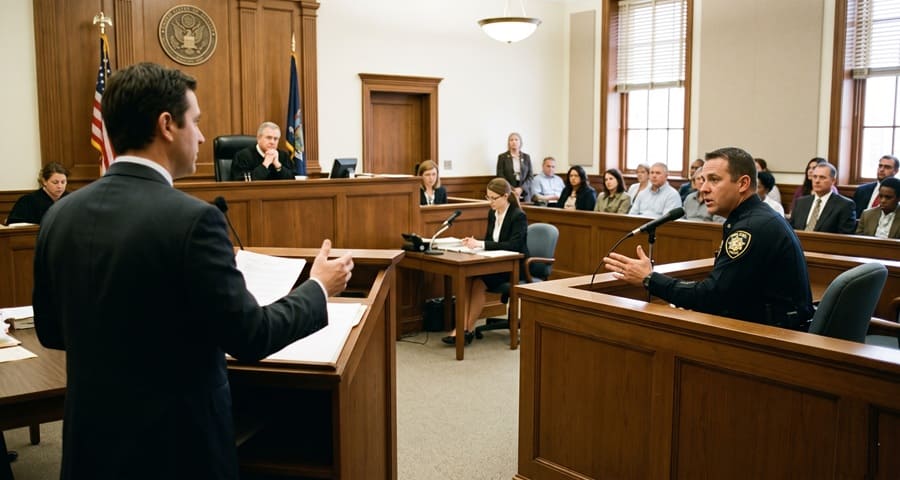
In California courts, police officers testify like any other witness. Their training and experience may make their statements seem more credible to jurors, but credibility isn’t automatic. An officer’s testimony can be questioned, challenged and discredited, just like anything another witness says.
Judges and juries decide whether testimony is reliable. When they hear an officer testify, they are expected to look at whether the account is consistent, whether other evidence supports it and whether anything may have influenced it.
Bias Isn’t the Same as Lying
Bias, in this context, means anything that may affect how a person perceives, describes or recalls events. The word has a negative ring, but a biased witness isn’t necessarily lying or acting in bad faith. Bias is often subtle or entirely unconscious. People who sincerely believe they are objective can still have patterns in their thinking that color what they report.
Common forms of bias that may affect police testimony include:
- Confirmation bias: interpreting facts or statements in a way that supports an existing assumption or suspicion.
- Personal bias: preexisting attitudes toward certain individuals or groups.
- Institutional pressure: pressure to justify an arrest or support a fellow officer’s actions, whether or not they were lawful.
- Memory distortion: changes in memory over time, especially after repeated retellings or exposure to other people’s versions of events.
- Self-interest: in a use-of-force case, an officer may face discipline, a lawsuit or even prosecution, which gives the officer a personal stake in how the incident is described.
Even a small, unconscious bias can affect every part of a case, from how an officer reads a scene to how evidence is collected and how decisions are explained afterward.
Where Bias Tends to Show Up
Bias can surface in many kinds of police encounters. Common examples include:
- arrests based on limited or changing information
- reports written hours or days later, from memory rather than real-time notes
- differences between civilian witness statements and an officer’s account
- high-stress encounters, especially use-of-force incidents, where perception narrows
- cases that rest on an officer’s interpretation, such as DUI arrests or alleged resisting arrest
- reports written after an officer has watched body-camera footage or talked with other officers, which can blend what they saw with what they later learned
In each of these situations, what an officer genuinely believes happened may not be what actually happened.
How Attorneys Test an Officer’s Account
A careful California police misconduct attorney does not take a police report at face value. The aim is to measure the officer’s version against everything else available. That work often includes:
- comparing police reports with body-camera and dashcam footage
- collecting surveillance video from nearby businesses and homes
- reviewing 911 calls, dispatch logs and radio traffic
- looking for differences between the first report and later statements, interviews or deposition testimony
- consulting experts on use of force, police practices or forensic evidence
- investigating the officer’s background to the extent the law allows
That last step has specific legal routes in California. A Pitchess motion under Evidence Code sections 1043 and 1045 asks a court to review an officer’s personnel file privately and release relevant complaints, such as prior findings of dishonesty or excessive force. Since SB 1421 took effect in 2019, and SB 16 expanded it in 2022, Penal Code section 832.7 also makes certain records public, including sustained findings of dishonesty and of unlawful arrests, unlawful searches and biased conduct. In criminal cases, prosecutors have a constitutional duty under Brady v. Maryland to disclose evidence favorable to the defense, which the California Supreme Court has held can include information that undermines an officer’s credibility (People v. Superior Court (Johnson), 2015).
When the Evidence Told a Different Story: The Costco Shooting Case
One case handled by the Law Offices of Dale K. Galipo shows how much rides on testing an officer’s account. In 2019, an off-duty Los Angeles police officer shot and killed a 32-year-old man inside a Costco in Corona and seriously wounded the man’s parents. The officer told investigators he believed the man had a gun and that his own life and his young son’s were in danger. According to news reports on the verdict, the man was unarmed and moving away when the officer fired, and the LAPD’s civilian Police Commission later found that the use of deadly force was not objectively reasonable.
In 2021, a federal jury in Riverside awarded the family $17 million in French v. City of Los Angeles and found that the officer had been acting within the scope of his employment. The case appears on the firm’s list of verdicts and settlements.
Past results do not guarantee a similar outcome. Each case turns on its own facts, the available evidence and the law that applies.
If an Officer’s Account Doesn’t Match What Happened
If you believe an officer’s report or testimony misstates what happened, a few steps can help preserve your position:
- Write down your own account as soon as possible, including times, names and badge numbers.
- Identify any witnesses and nearby cameras right away, since private video is often recorded over within days.
- Request the police report and keep copies of every document you receive.
- Get medical care for any injuries and keep the records.
- Be careful about public posts; anything you write can be used to challenge your own credibility.
Claims against a public entity in California generally require a written government claim within six months under the Government Claims Act (Government Code § 911.2), and federal civil rights claims have their own deadlines, so it is worth getting advice early.
Disclaimer
This article provides general information about California law and is not legal advice. Reading it does not create an attorney-client relationship. The outcome of any criminal or civil case depends on its specific facts and the law that applies. For advice about your situation, consult a lawyer licensed in California.
