
Currently Empty: $0.00

California Truck Corridors and the Rising Risk of Commercial Vehicle Accidents Near Port Cities
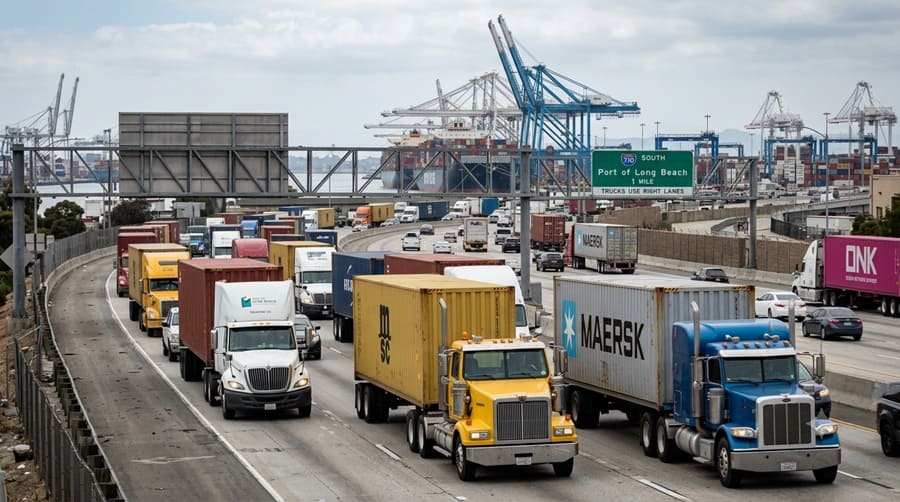
Drive the I-710 south of Los Angeles on any given weekday morning and you will quickly understand why traffic safety researchers keep their eyes on this stretch of asphalt. Long-haul diesels pulling 40-foot containers stack up bumper to bumper as they push toward the twin port terminals of Los Angeles and Long Beach. The same scene plays out in different forms on I-5 through the Central Valley and on SR-99 near Fresno, where agricultural and warehouse freight moves around the clock.
The volume is not slowing down. The Port of Long Beach alone handles cargo worth roughly $200 billion annually, and post-pandemic demand surges pushed truck traffic on the I-710 up by about 50 percent compared to January 2020 benchmarks. That growth in freight movement has a shadow: a corresponding rise in commercial vehicle accidents on the corridors that keep goods flowing.
For drivers who share these roads with 80,000-pound rigs, understanding what is driving this trend matters. So does knowing your options if something goes wrong. A qualified truck accident lawyer can help victims navigate the regulatory complexity that follows a serious commercial vehicle crash in California.
The Freight Boom Behind the Accident Numbers
Southern California’s port complex is the busiest container gateway in North America. Cargo ships unload containers at the terminals, and those containers almost immediately get transferred to diesel trucks that fan out across the region. The I-710, which connects the Port of Long Beach directly to the rail yards near the I-710/I-5 interchange, is described by the California Department of Transportation as having some of the heaviest freight volumes in the state.
Further north, SR-99 and I-5 handle the flow of agricultural products out of the Central Valley, along with goods bound for and from the Inland Empire’s massive warehouse clusters. Fresno sits at the geographic center of this system, making it a key node for trucking activity year-round.
When freight volumes rise, so does exposure. More trucks on the road for more hours means more opportunities for fatigue, mechanical failure, and driver error that cause serious crashes. California data backs this up.
What the Numbers Tell Us
The crash statistics for California’s commercial vehicle corridors are sobering.
- FMCSA data for 2024 shows 12,243 large trucks involved in crashes statewide, resulting in 321 deaths and 5,097 nonfatal injuries.
- California ranked second in the nation for large truck crash fatalities in 2023, with 392 deaths, trailing only Texas.
- Los Angeles County alone recorded 1,731 truck accidents involving injury in 2024, with 44 deaths and over 2,300 total injuries from semi-truck impacts.
- UCI research found that large trucks account for 9.1% of California’s fatal crashes despite representing only 2.5% of the vehicle population.
These figures are not abstract. They represent drivers heading to work, families on the freeway, and pedestrians near port access roads who were in the wrong place when a commercial vehicle failed to stop, swerved out of its lane, or lost a load.
Common Causes of Truck Accidents on California’s Port Corridors
Crashes rarely happen for a single reason. The most serious commercial vehicle accidents on California’s freight corridors typically involve a combination of the following factors.
Driver Fatigue
Long-haul trucking demands extended hours, and fatigue is one of the most frequently cited contributors to serious crashes. Human factors are cited in nearly 90% of truck-related crashes, with fatigue, distraction, and impaired driving leading the list.
Mechanical Failures
Commercial trucks cover enormous mileages under heavy load conditions. Brake failures and tire blowouts are particularly dangerous on high-speed corridors like I-5. Neglected maintenance schedules are a recurring issue, especially among smaller carriers operating with thin margins.
Corridor Congestion
The I-710, I-5, and SR-99 all experience heavy commercial traffic concentrated into defined time windows. Stop-and-go conditions on corridors designed for sustained highway speeds create conditions where rear-end collisions and lane-change accidents happen at higher rates.
Cargo Securement Failures
Improperly loaded or secured cargo can shift during transit, altering a truck’s center of gravity and causing rollovers or spilling into traffic. Both drivers and loading personnel share responsibility under California law for ensuring cargo is properly secured before and during a trip.
How California’s Trucking Regulations Set the Legal Baseline
California does not simply adopt the federal floor on commercial vehicle safety. The state builds on FMCSA standards with additional requirements that, when violated, can form the core of a commercial vehicle crash claim.
Stricter Inspection Requirements
Under California trucking regulations, commercial trucks must be inspected at least once every 90 days, with inspection reports maintained for at least two years. Brake systems, steering and suspension systems, tires, wheels, and vehicle connecting devices all fall under this mandate. A missed inspection cycle that precedes a brake failure is the kind of documented violation that strengthens a negligence claim significantly.
Weight Limits and Vehicle Standards
California enforces its own weight limits and equipment standards through the California Highway Patrol and Department of Transportation. California-specific trucking laws often impose stricter safety rules than federal regulations, covering vehicle weight, driver conduct, inspections, and drug testing. Overloaded trucks that struggle to brake or maneuver safely are a known crash risk on crowded corridors.
Hours of Service and Driver Qualifications
FMCSA hours-of-service rules limit driving time to prevent fatigue, and electronic logging devices (ELDs) are required to track those hours accurately. Drug and alcohol testing, including pre-employment, random, and post-accident testing, is mandatory. California has historically pushed for stricter break requirements, and while federal preemption has complicated some of those rules, violations of FMCSA standards can be powerful evidence of negligence in a personal injury claim.
Regulatory Violations and Layered Liability
One of the features that makes commercial vehicle crash claims in California more complex than typical car accident cases is the layered liability structure. Multiple parties can share responsibility: the driver, the trucking company, a maintenance contractor, a loading company, and in some cases, the shipper.
When a crash involves regulatory violations, the legal picture becomes clearer, not murkier. Violations of FMCSA standards combined with California trucking regulations create layered liability, especially in commercial truck accident claims involving severe injuries. The key is that federal standards create minimum floors, but California often pushes those requirements higher.
The California Court of Appeals reinforced this in a significant decision holding that instructing a jury on California’s basic speed law rather than the federal ‘extreme caution’ standard for commercial vehicles was a prejudicial error. Federal Motor Carrier Safety Regulations can impose duties beyond ordinary negligence standards, creating enhanced liability for commercial truck operators.
For anyone seriously hurt in a truck accident on I-710, I-5, or SR-99, this regulatory framework is not background noise. It is the foundation of the legal claim. Early investigation matters because electronic logging data, maintenance records, and inspection reports can disappear or become inaccessible if not preserved quickly. The Long Beach personal injury attorneys at Roxell Richards have experience handling these cases and can help preserve critical evidence from the start.
Frequently Asked Questions About Truck Accidents Near California Port Corridors
What are the most dangerous highways for truck accidents in California?
I-5, I-710, SR-99, and I-10 consistently appear in California crash data as high-incident corridors for commercial vehicle accidents, largely because they carry disproportionate shares of the state’s freight volume. The I-710, which connects the Port of Long Beach to the rail yards near Los Angeles, sees particularly heavy concentrations of semi-truck traffic.
What are the most common causes of truck accidents in California?
Driver fatigue, brake failures, tire blowouts, cargo securement failures, and speeding in congested zones are among the most frequently documented causes. Human factors, including fatigue and distraction, are cited in the majority of serious crashes.
How does California law differ from federal FMCSA rules in truck accident cases?
California adopts FMCSA standards as a baseline and then layers additional state-specific requirements on top, covering inspection intervals, weight limits, and equipment standards. When both sets of rules are violated, the liability exposure for trucking companies and their insurers increases significantly.
What should I do if I am injured in a commercial vehicle crash?
Seek medical attention immediately, document the scene as thoroughly as possible, and obtain a copy of the police report. Avoid giving recorded statements to insurance adjusters before speaking with an attorney. Evidence like black-box data, driver logs, and maintenance records can become unavailable quickly, so legal consultation early in the process is important.
What Victims of Commercial Vehicle Crashes Should Know
California’s freight corridors are economic arteries, and keeping them productive requires an enormous daily commitment from thousands of truck drivers, carriers, dispatchers, and logistics companies. Most do their jobs safely. But the scale of the system, combined with competitive pressure on drivers and carriers, creates conditions where safety shortcuts happen.
When those shortcuts lead to serious injuries, the regulatory record becomes a roadmap. A missed inspection. A falsified logbook. An overloaded trailer. Each of these represents a documented failure to meet a legal standard that existed specifically to prevent crashes.
For injured victims and their families, the path forward involves understanding that commercial vehicle crash claims are fundamentally different from car accident cases. The vehicles are bigger, the injuries are often more severe, the insurance minimums are higher, and the legal framework is more complex. Federal minimum liability coverage for commercial trucks can range from $750,000 to $5 million, depending on the cargo type and vehicle size.
Victims deserve attorneys who understand both the federal regulatory system and California’s stricter state framework. The Long Beach personal injury attorneys at Roxell Richards have experience navigating the layered liability and regulatory complexity that define commercial vehicle crash cases in Southern California. Getting legal guidance early can be the difference between preserving critical evidence and losing it.
Conclusion
California’s port corridors are among the most heavily trafficked freight routes in North America, and the commercial vehicle accident numbers reflect that reality. I-710, I-5, and SR-99 carry economic value that benefits the entire country, but they also carry risk for every driver who shares the road with an 80,000-pound commercial truck.
Understanding what drives those accidents, and how California’s regulatory framework shapes liability when they happen, is the first step toward protecting yourself and your rights. The rules exist for a reason. When they are ignored, accountability follows.